Best Things to Do in Japan 2026: Top Experiences & Itinerary

Japan is the rare country that delivers on every version of the trip you picture. You can spend a morning in a neon canyon of screens and arcades, then walk into a 1,400-year-old temple by lunch. You can slurp ramen at a counter the size of a hallway, sleep on a futon beside a hot spring, and watch deer bow for crackers all in the same week. The hard part is not finding things to do. It is choosing.
This guide walks you through the experiences that earn their reputation, city by city, plus the day trips worth the train fare and a few places beyond the usual route. At the end you will find a sample 7 to 10 day itinerary you can lift straight into your own plans. Whether this is your first visit or your fourth, there is a version of Japan here for you.
TL;DR
- Tokyo is your high-energy base: Shibuya Crossing, Senso-ji in Asakusa, the digital art of teamLab, and the neon backstreets of Shinjuku.
- Kyoto is the cultural heart: the Fushimi Inari torii gates, Arashiyama bamboo grove, the gold-leafed Kinkaku-ji, and the lantern-lit lanes of Gion.
- Osaka is where you come to eat. Dotonbori, takoyaki and okonomiyaki, and a full day at Universal Studios Japan.
- Day trips are easy by train: Nara's free-roaming deer, Hakone's onsen and Mount Fuji views, and the shrines of Nikko.
- Beyond the Golden Route, Hiroshima and Miyajima reward a longer trip, while Hokkaido and Okinawa offer powder snow and tropical beaches.
- A classic first-timer plan is the Golden Route: Tokyo, Hakone, Kyoto, Osaka over 7 to 10 days, all linked by the bullet train.
Tokyo: where the trip usually begins
Most journeys start in Tokyo, and it sets the tone. The city stitches together the futuristic and the ancient with no warning, so one block is all screens and crowds and the next is a quiet shrine garden.
Start with Shibuya Crossing, the scramble where waves of people pour across from every direction at once. Watch it from a window seat in a café above the intersection, then find the Hachiko statue just outside the station for the photo everyone takes. From there the contrast hits fast. Head to Asakusa for Senso-ji, Tokyo's oldest temple, founded in 645. Go before 8am if you can, while the Nakamise shopping street is still calm and the giant red Kaminarimon lantern is yours alone. The grounds stay open late too, so an evening visit under glowing lanterns is quieter and a little haunting.
For something that feels like nowhere else, book teamLab. There are two venues, and they are different experiences. teamLab Borderless in Azabudai Hills is a sprawling maze of digital installations that flow between rooms and react to you as you move. teamLab Planets in Toyosu is the one where you wade barefoot through water. Tickets sell out, so reserve online ahead of time rather than chancing the door.
End the day in Shinjuku, which does neon better than anywhere. Wander the lantern-strung alleys of Omoide Yokocho for grilled yakitori under the train tracks, or the tiny stacked bars of Golden Gai, some barely big enough for six stools. Three days covers Tokyo's headline sights, though five lets you breathe and slip into a few neighborhoods at your own pace.
Kyoto: the Japan from the postcards
If Tokyo is the future, Kyoto is the memory. With more than 2,000 temples and shrines, it looks like the country you pictured before you booked.
The image that pulls most people here is Fushimi Inari Taisha, where thousands of vermillion torii gates tunnel up a forested mountainside. Entry is free, and you can walk as far as you like. The catch is timing. Arrive before 8am or after 4pm, because by mid-morning the lower gates are shoulder to shoulder. Push past the first stretch and the crowds thin quickly as you climb toward the Yotsutsuji viewpoint over the city.
Across town, Arashiyama holds the famous bamboo grove, where towering green stalks filter the light into something soft and otherworldly. The same advice applies: get there at 7 or 8am and you will have the path nearly to yourself. While you are out west, the gold-leafed Kinkaku-ji, the Golden Pavilion, mirrored in its own pond, lives up to the hype in early light. Over in Higashiyama, Kiyomizu-dera spreads its wooden stage out over the hillside with sweeping views back across Kyoto.
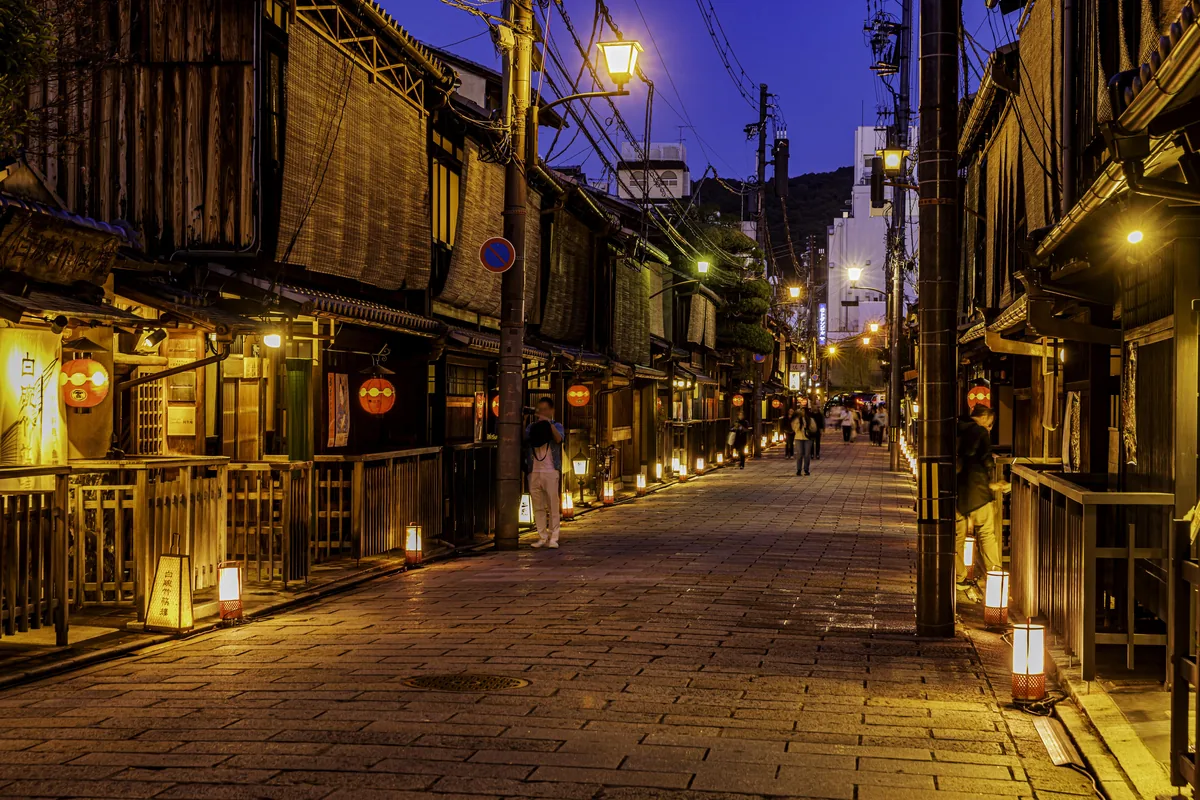
Save your evening for Gion, the old geisha district of wooden teahouses and lantern-lit lanes. You may spot a geisha or maiko hurrying to an appointment, but be respectful. The private alleys have been closed to tourists since 2024, and photographing geisha without permission can land you a fine. Stick to the main streets and let the atmosphere do the work.
Osaka: come hungry
Osaka is Japan's kitchen, and it knows it. The city is louder, friendlier, and more about pleasure than ceremony, which makes it the perfect counterweight to Kyoto's calm.
Everything orbits Dotonbori, a canal-side strip drowning in neon signs, giant mechanical crabs, and the smell of frying batter. This is the home of takoyaki, octopus-filled dough balls turned with a pick, and okonomiyaki, a savory pancake you often grill at your own table. Eat your way down the street, then loop back at night when the lights reflect off the water. Locals call the spirit of it all kuidaore, roughly "eat until you drop," and it is a fair warning.
If you are traveling with kids or you just love a good ride, give a full day to Universal Studios Japan. The Wizarding World of Harry Potter, the Super Nintendo World, and the seasonal parades pull big crowds, so an early start and a timed-entry ticket save you hours of queuing. Osaka also makes the easiest base for the day trips in the next section, since Nara and Kyoto are both a short hop away.
Day trips worth the train fare
Japan's rail network turns nearby gems into easy half- or full-day outings. These three are the ones people rarely regret.
Nara sits about 35 to 45 minutes from Osaka or Kyoto, and it earns a full day. Over 1,200 sika deer roam free through a UNESCO-listed park, bowing for crackers you can buy from vendors for a few hundred yen. The crackers are sugar-free and made just for them. Beyond the deer, you will find Todai-ji, whose great wooden hall shelters a giant bronze Buddha, and the lantern-lined paths of Kasuga Taisha. It is also one of the more affordable days you will spend in Japan.
Hakone is where Tokyo goes to exhale. Under two hours from the city, it sits in a national park built around Mount Fuji, hot springs, and Lake Ashi. The classic loop strings together a lake cruise, the Hakone Ropeway up to the steaming volcanic valley of Owakudani, where you can eat eggs blackened in the sulphur springs, and a long soak in an onsen with Fuji on the horizon. A word of patience: the mountain is shy and hides behind cloud more than half the year, so morning is your best window. The Hakone Free Pass covers most local transport and pays for itself quickly.
Nikko, about 90 minutes north of Tokyo, is a UNESCO World Heritage site wrapped in cedar forest. The lavish Toshogu Shrine is the draw, a complex of 55 buildings dripping with gold and intricate carvings, including the famous three wise monkeys and a sleeping cat. Arrive by 9am on a weekday to beat the tour buses, then carry on to Kegon Falls and Lake Chuzenji if the day is clear.
Beyond the Golden Route
Once you have done the classics, Japan opens up. These regions reward a second trip, or a longer first one.
Hiroshima turns a difficult history into something quietly moving. The Peace Memorial Park, the skeletal Atomic Bomb Dome, and the museum tell the story of 1945 with care, and a few hours there stay with you. Do not leave without trying its signature okonomiyaki, layered rather than mixed, with a nest of fried noodles built in. Just offshore, the island of Miyajima is the antidote: the floating vermillion torii gate of Itsukushima Shrine appears to hover on the tide. Time your visit around the tide tables, since at high water the gate seems to drift on the sea, while at low tide you can walk out across the flats to its base. Ride the ropeway up Mount Misen for sweeping Inland Sea views, watch for the wild deer in the lanes, and sample the grilled oysters and maple-leaf cakes. Both fit a long day, though staying a night lets the island empty out after the day-trippers leave.
Hokkaido, the northern island, swings between two seasons. In winter, Niseko delivers some of the lightest powder snow on earth and the Sapporo Snow Festival fills the streets with towering ice sculptures every February. In summer, the lavender and sunflower fields of Furano bloom and the mountain trails open for hiking. Okinawa, far to the south, is Japan's tropical side: white-sand beaches, coral reefs that rank among Asia's best for diving, and the Churaumi Aquarium with one of the largest tanks in the world. Spring and autumn are the sweet spots there. With more time, hop a short flight to the smaller Yaeyama Islands, where Ishigaki and Taketomi feel a world away, all turquoise shallows and red-tiled village houses.
Kanazawa, on the Sea of Japan coast, is the city people wish they had given more days. It came through the war untouched, so its old samurai and geisha districts still stand intact. The centerpiece is Kenroku-en, widely held to be one of the three great gardens of Japan, beautiful in every season from plum blossom to the snow ropes that prop up its pines in winter. Pair it with the contemporary art of the 21st Century Museum next door and the seafood of the Omicho market, all within about two and a half hours of Tokyo by bullet train.
For mountains and old timber towns, aim for the Japan Alps. Takayama, in the Hida highlands, keeps a beautifully preserved old town of dark wooden merchant houses, riverside morning markets, and sake breweries you can taste your way through. From there a short bus ride reaches Shirakawa-go, a UNESCO village of steep thatched farmhouses that looks like a folk tale when the winter lights come on. Add nearby Kamikochi in warmer months for dramatic alpine valley walks.
The northeast, Tohoku, stays gloriously uncrowded even in peak season. Go for raw landscape and deep tradition: the pine-dotted islands of Matsushima Bay, the pilgrim trails of the Dewa Sanzan mountains, and beloved summer festivals like Aomori's giant illuminated Nebuta floats. Cherry blossoms arrive weeks later than in Tokyo, so a late-April trip can let you chase the bloom a second time.
Cultural experiences that go deeper
Beyond the sights, a few experiences slow the trip down and stick with you.
An onsen is non-negotiable. Soaking in a natural hot spring, ideally at a traditional ryokan inn with a multi-course dinner and a futon on tatami, is one of the most relaxing things you can do in Japan. Learn the etiquette first: you wash thoroughly before you get in, and the bath itself is for soaking, not scrubbing.
And the temples and shrines are not just photo stops. Buy a goshuin stamp book, watch a tea ceremony, or simply sit for ten minutes in a moss garden and let the noise drop away. The food, which gets its own section below, is reason enough to come on its own.
Themed days for every kind of traveler
One of the joys of Japan is that you can build a day around almost any passion.
If you grew up on anime and games, give Tokyo's Akihabara an afternoon, stacked floor upon floor with figures, retro game cartridges, arcades, and themed cafés. Nakano Broadway is the quieter collector's paradise, while the Ghibli Museum in Mitaka and Ghibli Park near Nagoya turn the studio's films into real spaces (both reward booking ahead).
The theme parks are a category of their own. Tokyo Disneyland and the neighboring DisneySea, the latter found nowhere else on earth, sit just outside the capital. Osaka's Universal Studios Japan anchors the west, and Fuji-Q Highland pairs record-breaking coasters with a backdrop of Mount Fuji itself.
For a slower theme, build a trip around onsen towns. Beyond Hakone, Kinosaki hands you a yukata robe and wooden sandals and sends you between seven public bathhouses along a willow-lined canal. Beppu, on Kyushu, sits on so much geothermal energy that steam rises off the streets, and Ginzan Onsen is at its most magical under winter snow.
For pure spectacle, catch a sumo tournament, held across the year in Tokyo, Osaka, Nagoya, and Fukuoka. On non-tournament days you can sometimes watch a morning practice at a training stable instead.
Where the food becomes the trip
You could plan an entire visit around eating, and plenty of people do.
Treat yourself to sushi at least once at a proper counter, where the chef hands each piece across one at a time and the rice is still faintly warm. For ramen, lean into regional styles: rich tonkotsu in Fukuoka, miso bowls in Sapporo, soy-based broths in Tokyo. Many counters run a ticket machine at the door, so you pay first and hand over the stub.
For the social side, spend an evening in an izakaya, where small plates of grilled skewers, sashimi, and fried morsels keep arriving alongside cold beer or sake. At the other end of the scale, a kaiseki dinner, often served at a ryokan, is a slow procession of tiny seasonal courses plated like art.
Do not overlook the everyday wonders either. The basement depachika food halls beneath the department stores are a feast for the eyes, while convenience stores turn out genuinely good rice balls and hot snacks at all hours. And no trip is complete without grazing the street stalls, from a taiyaki fish-shaped cake to a skewer of grilled mochi.
Traveling Japan with kids
Japan is one of the easier countries to enjoy with children, and not only because of the theme parks. The trains themselves are an event, and bento boxes eaten at your seat keep small travelers happy on longer legs. Cities are clean and safe, with family restrooms in most stations and malls.
Animal encounters are an easy win. Nara's bowing deer delight kids of every age, and the aquariums, including Okinawa's vast Churaumi tank, hold attention for hours. Science museums like Tokyo's Miraikan, craft workshops where children make their own food-replica keyrings, and the wade-through water rooms at teamLab Planets all land well. Build in a park or a riverside picnic between sights and the days flow far more smoothly.
Two off-the-beaten-path detours
When you are ready to step off the well-worn path, two ideas reward the effort. The first is Koyasan, a thousand-year-old Buddhist monastery town in the forests of Wakayama. Stay overnight in a temple lodging, share the monks' vegetarian cuisine, rise for morning prayers, and walk the lantern-lit Okunoin cemetery beneath towering cedars.
The second is the Kumano Kodo, a network of ancient pilgrimage trails threading between mountain shrines on the Kii Peninsula. Walk a single scenic stretch in a day or string several together, with hot-spring villages waiting at the end of the harder climbs. Few foreign visitors make it here, which is precisely the point.
A sample 7 to 10 day itinerary
The Golden Route links Tokyo, Hakone, Kyoto, and Osaka, and it remains the best first trip for good reason. Stretch it to ten days if you can, since two or three nights per city beats a rushed one. A Japan Rail Pass can make the bullet-train legs cheaper if your route is long enough to justify it.
| Days | Base | Highlights |
|---|---|---|
| 1 to 3 | Tokyo | Shibuya, Senso-ji, teamLab, Shinjuku, a sushi breakfast |
| 4 | Hakone | Lake Ashi, ropeway, onsen, Mount Fuji on a clear morning |
| 5 to 7 | Kyoto | Fushimi Inari, Arashiyama, Kinkaku-ji, Gion at dusk |
| 8 | Nara (day trip) | Deer park, Todai-ji, Kasuga Taisha |
| 9 to 10 | Osaka | Dotonbori, street food, Universal Studios Japan |
If you only have seven days, trim Osaka to a single night or skip Nara, and you will still see the best of the route. Spring (late March to early April) and autumn (October to November) bring the kindest weather and the famous colors, but they also bring crowds and higher prices, so book several months ahead. For the full breakdown of seasons, see our guide on the best time to visit Japan, and to keep the budget in check, how much a trip to Japan costs lays out real numbers.
An alternative route for a second visit
Once you have ticked off the classics, a second trip can dig deeper. This version swaps the busiest stops for the quieter heartland and the west over ten days.
| Days | Base | Highlights |
|---|---|---|
| 1 to 2 | Tokyo | Revisit a favorite, then day trips you skipped before |
| 3 to 4 | Takayama and Shirakawa-go | Old town, morning markets, thatched-roof village |
| 5 | Kanazawa | Kenroku-en garden, samurai district, Omicho market |
| 6 to 7 | Kyoto or Koyasan | Lesser-known temples, or an overnight temple stay |
| 8 to 10 | Hiroshima and Miyajima | Peace Park, floating torii gate, Inland Sea views |
You can run this on the same bullet-train backbone, picking up the Hokuriku line for the Sea of Japan coast. It trades headline sights for space to breathe, which is exactly what a return trip is for.
The bottom line
Japan gives you more than you can fit in one trip, which is the best problem a destination can have. Start with the Golden Route, lean into the onsen and the food, and leave a little room for the places that pull you off the obvious path. Whatever you choose, almost every part of the day runs through your phone here, from navigating the rail maze to translating a menu to holding your seat reservation on the Shinkansen. Sorting out data before you fly means you step off the plane already connected, with no roaming bill waiting at home. Our guide to the best eSIM for Japan covers coverage, how much data you actually need, and a few minutes of setup. Pair that with getting around Japan and you have the logistics handled before you pack.
Frequently asked questions
How many days do you need in Japan?
Seven to ten days is the sweet spot for a first visit, enough to cover the Golden Route of Tokyo, Hakone, Kyoto, and Osaka without rushing. With five days you can still see Tokyo and Kyoto well, but you will be moving fast. Two weeks lets you add Hiroshima or a side trip to Hokkaido or Okinawa.
What is the Golden Route in Japan?
It is the classic first-timer itinerary that connects Tokyo, Hakone (or the Mount Fuji area), Kyoto, and Osaka, sometimes extending to Hiroshima. The cities are linked by the Shinkansen bullet train, so you can travel between them in a few hours, and the route blends the modern and the traditional in one trip.
When is the best time to visit Japan?
Spring (late March to early April) for cherry blossoms and autumn (October to November) for fall colors offer the most pleasant weather, though both draw crowds and higher prices. Summer is hot and humid but great for Hokkaido and festivals, while winter is quieter and ideal for skiing and onsen.
Is Japan expensive to travel in?
It can be, but it is flexible. Accommodation and intercity transport are the biggest costs, while food can be very affordable thanks to convenience stores, ramen shops, and set-menu lunches. Many of the best experiences, including Fushimi Inari, Nara's deer park, and walking through Gion, are free.
Do I need to speak Japanese to travel in Japan?
No. Major train stations, signs, and tourist areas have English, and translation apps handle the rest. A few polite phrases go a long way, and the staff at most places will meet you halfway with patience and goodwill.
What should I not miss on a first trip to Japan?
If you do nothing else, see Senso-ji and teamLab in Tokyo, the torii gates of Fushimi Inari and the bamboo grove in Kyoto, eat your way through Dotonbori in Osaka, and soak in an onsen at least once. Add Nara's deer if your schedule allows.
How do I get around between cities in Japan?
The Shinkansen bullet train is the fastest and most comfortable option, linking Tokyo, Kyoto, Osaka, and Hiroshima in a few hours each. Within cities, the subway and rail systems are excellent and easy to navigate with a transit app. For the full picture, see getting around Japan.
Is Japan good for a family trip with children?
Very. The trains are an adventure in themselves, cities are clean and safe, and family facilities are easy to find. Kids tend to love Nara's deer, the big aquariums, the theme parks around Tokyo and Osaka, and the water rooms at teamLab Planets.
Where should I go in Japan beyond Tokyo and Kyoto?
For a deeper trip, Kanazawa offers a preserved old town and one of Japan's great gardens, the Japan Alps hide Takayama and the thatched village of Shirakawa-go, and Hiroshima pairs sobering history with the floating torii of Miyajima. Tohoku stays uncrowded, while Okinawa delivers tropical beaches.
What are the must-try foods in Japan?
Sushi from a proper counter, regional ramen like Fukuoka's tonkotsu and Sapporo's miso, a social evening of small plates at an izakaya, and a slow seasonal kaiseki dinner all belong on the list. Do not miss the department-store depachika food halls and street stalls for cheap snacks on the go.
Convinced?
Try Esim70 — plans from $1.36/day
150+ countries · Instant delivery · No commitment.