Getting Around Japan 2026: Trains, Metro & the JR Pass

Japan has one of the best public transport systems on the planet, and once you understand how the pieces fit together, getting around feels less like a logistics puzzle and more like a quiet superpower. Trains run on time to the minute. Stations are spotless and well signed in English. You can cross most of the country at 300 km/h on a bullet train, then tap a card to glide through a city subway without ever buying a paper ticket. The catch is that the network is big, the options overlap, and the rules changed in the last couple of years. This guide walks you through every realistic way to move around Japan in 2026, what each one roughly costs, and when it actually makes sense to use it.
TL;DR
- Trains are the backbone. The Shinkansen (bullet train) links the major cities fast, and dense local rail and subway lines cover everything in between.
- Get an IC card (Suica, Pasmo, ICOCA, and friends) on day one. You tap on, tap off, and it works on trains, subways, buses, and even vending machines nationwide.
- The nationwide Japan Rail Pass is no longer the automatic bargain it once was after its big 2023 price jump. It only pays off if you cover serious long distance ground in a short window. Run the numbers before you buy.
- City subways are cheap, frequent, and easy. Single rides usually run a couple of dollars, and 24 to 72 hour passes exist in Tokyo, Osaka, and Kyoto.
- Buses, trams, taxis, ride apps, and domestic flights all have their place, especially in Kyoto, rural areas, and for long hops where flying beats the train on price.
- Almost every step (route planning, ticket apps, maps, reservations) needs mobile data. Sort your connection before you fly.
The rail network and the Shinkansen
If you only learn one thing about Japanese transport, make it this: trains go almost everywhere, and the system splits broadly into Japan Railways (JR) lines and a tangle of private railways, subways, and trams. JR runs the long distance trains, including the famous Shinkansen, plus many of the commuter lines inside cities. Private operators fill in the gaps, often serving specific suburbs, tourist areas, and routes the JR network skips.
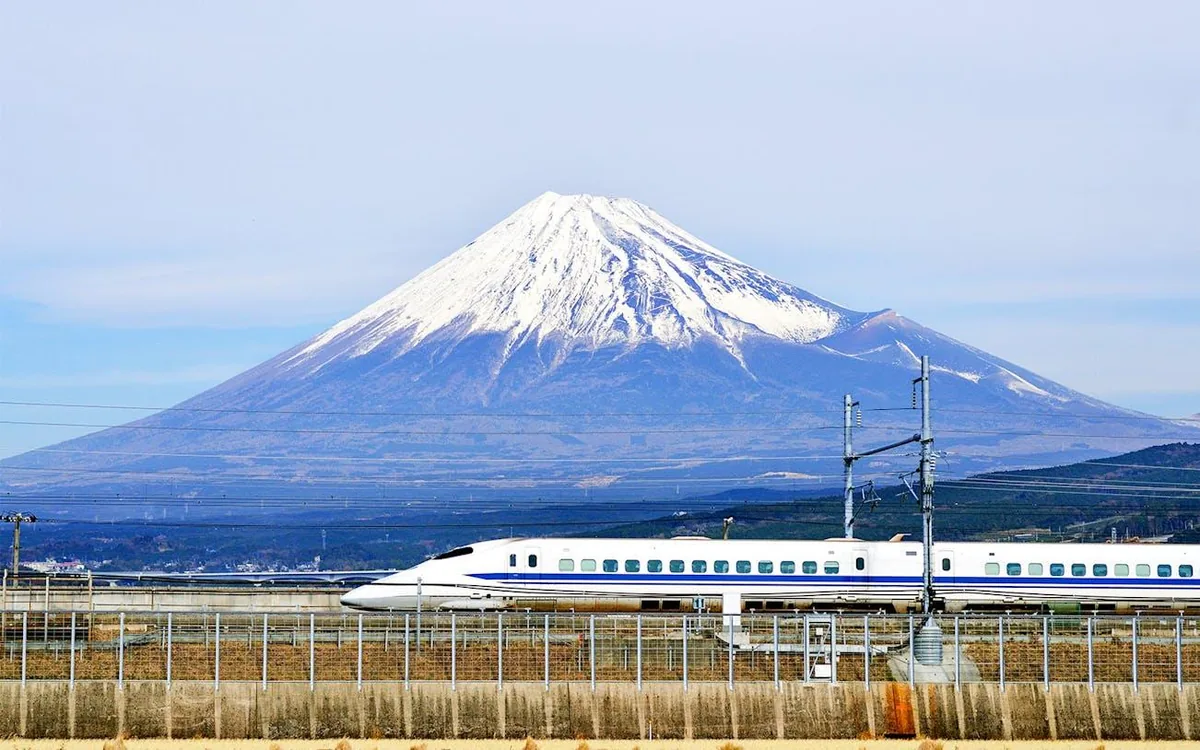
The Shinkansen is the star. These bullet trains connect Tokyo, Kyoto, Osaka, Hiroshima, and dozens of other cities at remarkable speed, and they leave with the kind of punctuality that makes first-time visitors laugh out loud. Tokyo to Kyoto takes a little over two hours and runs many times an hour. Fares are distance based and fixed, so they do not surge the way flights do, though there are small seasonal seat surcharges in peak periods. A one-way reserved seat from Tokyo to Kyoto sits in the region of ¥14,000 (roughly US$90 to US$100 at recent exchange rates), with a Green Car (first class) seat costing more. Prices vary, so treat these as ballpark figures rather than quotes.
A few practical notes. Reserved seats cost a little more than non-reserved but guarantee you a spot, which is worth it during holidays and weekends. The fastest service on the main Tokyo to Osaka corridor reaches Osaka in around two and a half hours. And you can book Shinkansen tickets through official online reservation apps, at station machines, or at ticket offices, with English options throughout.
The Japan Rail Pass: still worth it?
For years, the nationwide Japan Rail Pass was the default advice for any first trip. That changed in October 2023, when prices jumped by roughly 65 to 70 percent overnight. The pass still exists and still works the same way, giving you unlimited rides on most JR trains (including most Shinkansen) for a set number of consecutive days. But the math is very different now.
As of mid 2026, the nationwide Ordinary class pass costs about ¥50,000 for 7 days, ¥80,000 for 14 days, and ¥100,000 for 21 days when bought through the official channel. Note that overseas resellers were due to raise these figures from 1 October 2026 (to roughly ¥53,000, ¥84,000, and ¥105,000 respectively), so the exact price depends on where and when you buy. Always check the current rate before purchasing.
Here is the honest take. The pass only saves money if you pack a lot of long distance travel into a short window. A classic example: fly into Tokyo, ride the Shinkansen to Kyoto and Osaka, take a day trip to Hiroshima, then return to Tokyo, all inside seven days. That kind of itinerary can justify a 7 day pass. But if you are basing yourself in one or two cities, taking the odd intercity trip, and otherwise riding subways and buses, you will almost always come out ahead buying individual tickets.
| Your trip style | Buy individual tickets | Consider the JR Pass |
|---|---|---|
| One or two cities, mostly local travel | Yes | No |
| Tokyo plus one Shinkansen round trip | Usually yes | Maybe, run the numbers |
| Multiple long Shinkansen legs in 7 to 14 days | No | Often yes |
| Slow travel with long station gaps | Yes | Rarely worth it |
A quick way to decide: add up the one-way fares of the long distance trips you actually plan to take. If that total clears the pass price, the pass wins. If it does not, skip it. There are also cheaper regional JR passes (covering, say, just the Kansai area or just eastern Japan) that can be excellent value if your trip stays in one part of the country, so look at those before defaulting to the nationwide pass.
Regional rail passes worth knowing
This is where a lot of travelers leave money on the table. If your trip clusters in one part of the country, a regional JR pass often beats both individual tickets and the nationwide pass by a wide margin. The trade-off is that each one is locked to a specific area, so you have to match the pass to your route rather than the other way round. Here are the ones most likely to earn their keep, with rough 2026 prices to anchor on. Treat them as ballpark figures and confirm the current rate before you buy.
| Pass | Rough price | Best for |
|---|---|---|
| JR West Kansai-Hiroshima Area Pass (5 days) | around ¥17,000 | Kyoto, Osaka, Himeji, Okayama, Hiroshima and Miyajima |
| JR East Pass (5 days) | around ¥35,000 | Tokyo plus the north and east: Tohoku, Nikko, Nagano, Niigata |
| Hokkaido Rail Pass (5 days) | around ¥23,000 | Sapporo, Hakodate, Otaru and wider Hokkaido |
| Hakone Free Pass (2 to 3 days) | around ¥6,100 to ¥7,500 from Shinjuku | A Hakone hot spring loop from Tokyo |
The JR West Kansai-Hiroshima Area Pass is the standout if your itinerary is the classic golden route west of Osaka. For roughly ¥17,000 it gives you five consecutive days on JR trains in the Kansai region and along the Sanyo coast as far as Hiroshima, including the Sanyo Shinkansen between Shin-Osaka and Hiroshima and the JR ferry over to Miyajima. A single round trip from Osaka to Hiroshima alone gets you most of the way to the pass price, so if you are also doing day trips around Kyoto and Himeji it is an easy win.
The JR East Pass got a refresh in early 2026, merging what used to be separate Tohoku and Nagano-Niigata passes into one wider pass. For around ¥35,000 for five days (a 10-day version also exists), it covers Shinkansen and limited express trains across eastern and northern Honshu, which suits a trip that pairs Tokyo with somewhere like Nikko, the snow country, Sendai, or the deep north. It does not reach Kyoto or Osaka, so it is the wrong pass for a westbound trip.
The Hokkaido Rail Pass is the obvious pick if you are flying into Sapporo and exploring the north. Around ¥23,000 buys five consecutive days on JR trains and most JR buses across Hokkaido, with 7 and 10-day versions for longer stays. Distances up there are long and the scenery is the point, so the pass turns a region that is awkward to cover by single tickets into something simple.
Finally, the Hakone Free Pass is a different animal: a small area pass built around one of the most popular escapes from Tokyo. It bundles the round trip from Shinjuku on the Odakyu line with unlimited rides on the quirky transport that makes a Hakone loop fun, including the mountain railway, the cablecar and ropeway, the pirate ship across Lake Ashi, and local buses. Because Hakone deliberately routes you through several different operators in a single day, buying each leg separately adds up fast, so the pass is usually the sensible choice even for a quick overnight. There are similar small-area passes for other day-trip spots, so if you are circling one region heavily, it is always worth checking whether a dedicated pass exists.
IC cards (Suica, Pasmo, and the rest)
Whatever else you do, get an IC card. These rechargeable tap-to-pay cards are the single easiest upgrade to your trip. You load them with cash, tap them on the gate when you enter a station, tap again when you leave, and the correct fare is deducted automatically. No working out fares, no fumbling with paper tickets, no language barrier. The same card works on subways, JR trains, private railways, most city buses, and a surprising number of vending machines and convenience stores.
The cards go by different names depending on the region (Suica and Pasmo in the Tokyo area, ICOCA around Osaka and Kyoto, plus several others), but they are all interoperable. A Suica bought in Tokyo works perfectly fine on an Osaka subway, and vice versa, so you only need one.
There is a wrinkle worth knowing for 2026. A few years back, a global chip shortage led to limits on the standard Suica and Pasmo cards. The workaround for visitors is the Welcome Suica, a tourist version that needs no deposit and stays valid for 28 days from first use. You can pick one up at Narita and Haneda airports and at major JR travel service centers in Tokyo such as Tokyo, Shinjuku, Ueno, Ikebukuro, and Shibuya stations. If you carry an iPhone, you can also add a mobile Suica to Apple Wallet and top it up straight from your phone, skipping the physical card entirely. The mobile route is the smoothest option if your device supports it.
A handy tip: keep a small running balance and top up at any station machine when it dips. Many machines take cash; some take cards. The tap-and-go convenience pays for itself within an hour of landing.
City subways and trains
Within Japan's big cities, the subway is your everyday workhorse. Tokyo's network is famously dense, run across two operators (Tokyo Metro and Toei), and it reaches almost anywhere you would want to go. Osaka and Kyoto have their own clean, frequent systems. Trains arrive every few minutes, signage is bilingual, and your IC card handles fares automatically, so day-to-day subway travel needs almost no planning.
If you expect to ride a lot in a single day, a subway day pass can beat pay-as-you-go. Rough 2026 prices to anchor on:
| City | Pass | Approx. price |
|---|---|---|
| Tokyo | 24 / 48 / 72 hour subway ticket | ¥1,000 / ¥1,500 / ¥2,000 |
| Osaka | 1 day Enjoy Eco Card | ¥600 to ¥800 |
| Kyoto | Subway and Bus 1 day pass | around ¥1,100 |
Whether a pass pays off depends on how many rides you cram in. As a rule, if you plan four or more separate journeys in a day, a day pass usually edges ahead. For lighter days, just tap your IC card and forget about it. One more thing to know about Tokyo: above ground, the JR Yamanote loop line circles the central districts and is often faster and simpler than the subway for hitting the big neighborhoods.
Buses and trams
Buses fill the gaps trains cannot reach, and in some places they are essential rather than optional. Kyoto is the classic case. Many of its most famous temples sit away from train and subway lines, so the city bus network does a lot of the heavy lifting, and a bus day pass can be genuinely useful there. Rural towns, mountain trailheads, and hot spring resorts also rely on buses, often timed loosely around train arrivals.
Boarding habits vary by region, which trips up first-timers. In many cities you board at the back, take a numbered ticket, and pay the fare shown on a display when you get off at the front. In others, especially flat-fare city services, you pay as you board. Your IC card works on most buses, which sidesteps the confusion entirely, so tap on and tap off where the system supports it. A handful of cities also run charming streetcars and trams, like Hiroshima and Nagasaki, which double as a pleasant, slow way to see the city. For longer distances, intercity highway buses are a budget alternative to the Shinkansen, with overnight services that save you a night of accommodation, though they trade speed and comfort for the lower fare.
Taxis and ride apps
Taxis in Japan are clean, safe, and reliable, with doors that open automatically and drivers who take pride in the job. They are also expensive compared with public transport, so they suit specific moments rather than everyday travel: late nights after the trains stop, heavy luggage, a group splitting the cost, or a destination that is awkward to reach by rail. In Tokyo, expect a base fare around ¥500 for the first kilometer or so, with the meter climbing steadily after that. A 10 km ride can land somewhere near ¥4,500 in normal traffic, and late-night rides carry a surcharge. Prices vary by city and time of day.
Ride-hailing in Japan works a little differently from elsewhere. There is no widespread private-driver model the way some countries have; apps mostly dispatch licensed taxis. The most established taxi app covers nearly the whole country, supports English, and accepts foreign credit cards, which makes it the easiest option for visitors who do not want to hail on the street or explain a destination in Japanese. Coverage of other apps tends to thin out fast once you leave central city areas, so in regional spots, the established nationwide option is your safest bet.
Domestic flights
For long hops, flying can beat the train. The Shinkansen is hard to argue with up to a few hours of travel because it drops you in the city center and needs no security line, but once distances stretch out, a plane wins on time and sometimes on price. Tokyo to the southern island of Kyushu, or anywhere up to Hokkaido in the north, are natural flying routes.
Japan has full-service carriers and budget airlines, and the budget end can be very cheap if you book ahead. As a rough sense of scale, a one-way reserved Shinkansen seat from Tokyo to Osaka costs around ¥14,500, while budget airlines on that same route sometimes sell round-trip fares near ¥10,000 when booked well in advance. The honest trade-off is door-to-door time. A Tokyo to Osaka flight is barely over an hour in the air, but add airport transfers, check-in, and security, and the total can stretch to three or four hours, which is why the train still wins that particular matchup for most people. For longer distances, the flight's speed advantage grows and the calculus flips. If you want help weighing the overall budget, our guide on how much a trip to Japan costs puts transport in the context of the rest of your spending.
Airport transfers
Getting from the airport into the city is your first transport decision, and it is an easy one. From Tokyo's Narita Airport, the Narita Express (N'EX) runs a direct, comfortable train to Tokyo Station and other central hubs in under an hour, costing in the region of ¥3,000 one way. There is often a discounted round-trip ticket for visitors if you fly in and out of Narita within a couple of weeks, so it is worth asking. Cheaper bus and local train options exist too if you are not in a hurry.
For the Kansai region (Osaka and Kyoto), the Haruka limited express runs from Kansai International Airport. It reaches Osaka in around 50 minutes and Kyoto in roughly 75 to 80 minutes. A regular ticket to the Osaka area starts around ¥1,300, while the through service to Kyoto costs more (in the region of ¥2,850). Both airport expresses are covered if you happen to be using a relevant JR pass, which can sweeten the value of a regional pass. As always, confirm current fares when you book, since these figures shift.
Luggage forwarding and coin lockers
Here is a trick that quietly transforms how Japan feels to travel: you almost never have to drag heavy bags around. The country runs a slick door-to-door luggage delivery service, usually called takkyubin (sometimes written takuhaibin), that will collect a suitcase from your hotel and have it waiting at your next one, typically the following day. You hand it over at the front desk or a convenience store counter, fill in a short form, and pick it up at the other end. A single large case between major cities tends to cost somewhere in the region of ¥2,000 to ¥2,500, which feels like a bargain the first time you ride a crowded Shinkansen with nothing but a day bag. It is especially worth it when you are changing cities and would otherwise be wrestling luggage up station stairs or onto a packed train at rush hour.
The catch is timing. Standard delivery is next-day, so it works beautifully when you are moving on a day ahead of yourself, but it is not an option if you need the bag the same evening. The smart play is to send your big case ahead and travel light to the next stop, where it will be waiting.
For the in-between hours, coin lockers are everywhere. Most stations of any size have banks of them in several sizes, and they are the answer to the classic awkward gap when you have checked out of one hotel but cannot check into the next, or you want to explore a city on the way through without your bags. Fares run from a few hundred yen for a small locker up to around ¥700 to ¥1,000 for a large one per day, and many now take IC card payment, which saves hunting for coins. In the busiest hubs the big lockers fill up by mid-morning, so grab one early, and snap a photo of the locker number and bank location so you can find it again in a sprawling station.
Overnight buses and ferries
If your budget matters more than your time, two slower options can save you both money and a night's accommodation. Long-distance highway buses crisscross the country, and the overnight services are the interesting ones for visitors. You board in the evening in one city, sleep through the journey in a reclining seat, and arrive in another the next morning, having paid a fraction of the Shinkansen fare and skipped a hotel night. A Tokyo to Osaka or Tokyo to Kyoto overnight bus often costs well under half the price of the bullet train. The comfort gap is real, though. Even the better buses with wider seats and curtained partitions are not a flat bed, so this suits travelers who can sleep upright more than those who arrive needing to perform. Booking ahead is wise on weekends and around holidays.
Ferries are the other slow pleasure, and they are genuinely useful for reaching islands and for a handful of long coastal routes where flying feels like overkill. Short hops, like the few minutes across to Miyajima near Hiroshima or out to the art islands of the Seto Inland Sea, are cheap and frequent and form part of the fun. Longer overnight ferries link the main island of Honshu with Hokkaido, Kyushu, Shikoku, and Okinawa, with cabins ranging from open tatami-floored shared rooms to private berths. They will never be the fastest way to travel, but for certain island-hopping itineraries they are the most characterful, and for getting a vehicle between islands they are often the only choice.
Cycling in the flatter cities
Trains and subways do the heavy lifting, but in flatter, more compact cities a rental bike can be the nicest way to cover the middle distances that are too far to walk and too short to bother with a train. Kyoto is the obvious example: it is largely flat, laid out on a grid, and packed with sights spaced just far enough apart that a bike turns a frustrating day of bus transfers into a breezy one. Other cities with calm backstreets and gentle terrain reward two wheels too.
Rental is easy. Shops near major stations rent city bikes by the day for roughly ¥1,000 to ¥1,500, and a growing number of cities run dock-based share schemes you unlock with an app, picking up and dropping off at ports around town. Two rules matter for staying out of trouble. First, park only in designated bicycle parking, because bikes left in the wrong spot can be impounded and reclaiming one is a tedious, paid hassle. Second, ride considerately: cycling is common on footpaths in many areas, but pedestrians have priority, and lights at night are expected. Sort your data connection and the share-bike apps and maps do the rest.
Navigating big stations and the best route apps
Japan's giant stations can look intimidating on paper, and a few of them genuinely are sprawling, multi-level complexes with dozens of exits. The good news is they are built to be navigated. Signage is bilingual and consistent, color-coded by line, and exits are numbered, so the trick is to stop thinking about the station as a whole and instead follow the one line color and exit number your app gives you. Knowing your exit number before you surface matters more than you would think, because in a place like Shinjuku or Tokyo Station, two exits can be a ten-minute walk apart and leave you on opposite sides of a neighborhood.
This is where a good route app does most of the work. Mapping apps are excellent in Japan and will hand you platform numbers, which carriage to board for the fastest transfer, exact transfer points, the fare, and live timetables, all in English. A couple of dedicated Japan transit apps go further with detailed train-by-train routing, clear handling of the JR-versus-private-railway split, and options to favor cheaper or fewer-transfer routes, which is handy when an app's default suggestion quietly routes you onto a pricier private line. Whichever you use, the workflow is the same: search the route, note the line color, platform, and exit number, and follow the signs. Every one of those apps needs a live data connection to give you live times and on-the-move rerouting, which is the single biggest reason to land already connected rather than hunting for station Wi-Fi.
Train etiquette that keeps things smooth
Part of why Japanese transport feels so calm is that almost everyone follows the same quiet, considerate habits, and slotting into them makes you a smoother traveler rather than the person everyone is side-eyeing. None of it is complicated.
- Keep it quiet. Trains are noticeably hushed, phones are kept on silent, and people avoid taking calls in the carriage. Chatting softly is fine; a loud video without headphones is not.
- Queue and let people off first. Markings on the platform show where doors will open and where to line up. You wait to the side, let passengers off, then board in order. This is why even crowded boarding feels orderly.
- Mind the priority seats. Most trains have seats reserved for elderly, disabled, pregnant, and injured passengers, usually marked in a different color near the doors. You can sit there when it is empty, but give the seat up promptly if someone who needs it boards.
- Do not eat on local trains and subways. Snacking on a short commuter ride is frowned upon. Long-distance trains are the exception, and eating a bento on the Shinkansen is a cheerful tradition, so the rule is really about packed local services rather than intercity travel.
- Backpacks off in a crowd. On a busy train, people slip a backpack off and hold it low or put it on the rack so it stops taking up another person's space.
Follow those and you will blend right in. They are less rigid rules than a shared courtesy, and the payoff is the unusually pleasant atmosphere that makes even rush hour bearable.
Accessibility and getting help
Japan's transport network is more accessible than many visitors expect, which is good news if you travel with a wheelchair, a stroller, or simply a lot of luggage. Almost all stations of any size have elevators and escalators, accessible toilets are widespread, and platform-to-train gaps on major lines are small and often bridged by staff. Tactile paving runs along platforms and through stations to guide visually impaired travelers, and trains announce stops audibly and on screens.
The piece that surprises people most is the staff. Station personnel will actively help passengers who need it: if you ask, staff at the departure station can arrange for a ramp to be brought to your carriage and will radio ahead so that someone meets you with a ramp at your destination, coordinating the whole journey. It is a normal, well-practiced service rather than a special favor, so do not hesitate to approach the staff window. A few practical notes help. Lifts can be tucked away at the far end of a long platform, so allow extra time to find them, and the very busiest stations at rush hour are worth avoiding with a wheelchair or stroller if your schedule is flexible. Larger Shinkansen trains have designated wheelchair-accessible seating that is best reserved in advance, since the spaces are limited.
The bottom line
Getting around Japan is genuinely one of the joys of the trip, not a chore. Tap an IC card for everyday city travel, lean on the Shinkansen for the big intercity legs, do the JR Pass math before assuming it saves you money, and reach for buses, taxis, or flights where they make sense. Get those four ideas straight and the whole country opens up.
The one thread running through all of it is connectivity. You will navigate stations with maps, check live train times, buy and reserve tickets in apps, top up a mobile Suica, and call a taxi, and every one of those steps needs mobile data. Public Wi-Fi in Japan is patchier than visitors expect, and it rarely reaches you on a platform or a backstreet when you need directions most. The cleanest fix is a travel eSIM that connects you the moment you land, with no roaming bill and no airport SIM queue. Our best eSIM for Japan guide covers coverage, setup, and what a plan should cost, and if you are not sure how big a plan to buy, how much data you need breaks it down by activity.
If you are still shaping the trip itself, it is worth reading up on the best time to visit Japan and the best things to do in Japan so your transport plan matches your itinerary.
Frequently asked questions
Do I need a Japan Rail Pass?
Only if you cover a lot of long distance ground in a short time. After the 2023 price increase, the nationwide pass costs roughly ¥50,000 for 7 days, so it pays off mainly for itineraries with several Shinkansen legs. For city-based trips with the odd intercity hop, individual tickets or a cheaper regional pass usually work out better. Add up your planned long distance fares and compare.
What is the best way to pay for trains and subways?
An IC card, hands down. Suica, Pasmo, ICOCA, and the rest are all interoperable, work nationwide on trains, subways, and most buses, and remove any need to calculate fares. Get a Welcome Suica at the airport, or add a mobile Suica to your iPhone, and just tap as you go.
How do I get from the airport to the city?
From Narita, the Narita Express runs direct to central Tokyo in under an hour for around ¥3,000. From Kansai Airport, the Haruka express reaches Osaka in about 50 minutes and Kyoto in roughly 75 to 80 minutes. Both have cheaper bus or local-train alternatives if you have time to spare.
Is it cheaper to fly or take the bullet train?
For trips up to a few hours, the Shinkansen usually wins once you factor in city-center stations and no security lines. For longer distances, like Tokyo to Kyushu or Hokkaido, budget flights often beat the train on both time and price, especially when booked weeks ahead.
Can I use Google Maps to get around Japan?
Yes, and it works very well, giving you platform numbers, transfer points, fares, and live timetables for trains, subways, and buses. It does need a live data connection to be useful on the move, which is the main reason a travel eSIM or local data plan is so handy here.
Are taxis worth using in Japan?
For everyday travel, no, since public transport is far cheaper and just as fast. Taxis shine for late nights after the trains stop, heavy luggage, groups splitting the fare, or hard-to-reach spots. A nationwide taxi app with English support and foreign-card payment makes booking one painless.
Do IC cards work all over Japan?
Yes. The major IC cards are interoperable across regions, so a card bought in Tokyo works on subways and trains in Osaka, Kyoto, and beyond. You only ever need one. Just keep a small balance topped up at any station machine.
Can I send my luggage between hotels instead of carrying it?
Yes, and it is one of the best-kept secrets of travel here. The takkyubin courier service will collect a suitcase from your hotel and deliver it to your next one, usually the following day, for roughly ¥2,000 to ¥2,500 per large bag. You arrange it at the front desk or a convenience store. Just remember it is next-day, so send bags ahead a day rather than expecting same-evening delivery, and travel light in between.
Is a regional rail pass better than the nationwide JR Pass?
Often, yes, if your trip stays in one part of the country. A regional pass like the Kansai-Hiroshima Area Pass (around ¥17,000 for 5 days) can cover a whole western itinerary for a fraction of the nationwide pass price. Match the pass to your route: the JR West pass for the Osaka-to-Hiroshima corridor, the JR East pass for Tokyo and the north, and the Hokkaido pass up north. Add up your planned fares and compare against both options before buying.
Convinced?
Try Esim70 — plans from $1.36/day
150+ countries · Instant delivery · No commitment.